Architecting Data Continuity: A Technical Analysis of Self-Healing Selectors and PerimeterX Bypass in PropTech Pipelines

1. The Real Estate Data Crisis: Navigating the $500B Valuation Gap
In the modern PropTech landscape, the delta between institutional alpha and market noise is defined by the quality of real-time property valuations. Reliable data underpins a $500 billion sector, yet the industry faces a systemic "valuation gap" caused by the fragility of traditional data acquisition. Official API channels have historically failed to provide granular valuations like Zestimates at scale, suffering from restrictive access policies and eventual deprecation. For infrastructure architects, the deprecation of the official Zillow API wasn't just a service outage; it was a signal that maintaining competitive market intelligence requires a shift toward more resilient, stateless integration patterns.

The Real Estate Data API fills this void by providing unencumbered access to Zillow, Redfin, and MLS data—sources that were previously siloed or prohibitively expensive.
Feature | Official Zillow API (Deprecated) | Real Estate Data API |
Approval Process | Manual (Weeks/Months) | Immediate Stateless Access |
Zpid Lookup | Restricted/Legacy | Full Native Support |
Rate Limits | Strict & Non-Negotiable | Managed via Stealth Orchestration |
Data Scope | Single-Source (Zillow) | Multi-Source (Zillow, Redfin, MLS) |
Resilience | Static DOM mapping | AI-Powered Self-Healing |
Valuations | Limited Zestimate Access | Full Zestimate & Rent Zestimate |
The primary technical moat defending these data "walled gardens" is PerimeterX (now HUMAN Security). This is the same high-security "Unicorn" shielding system utilized by Ticketmaster, Nike SNKRS, and Supreme to prevent automated inventory sniping.
PerimeterX employs advanced TLS fingerprinting, browser profile analysis, and behavioral heuristics to flag non-human traffic. For traditional scrapers, these barriers manifest as consistent 403 Forbidden errors or infinite CAPTCHA loops, creating a massive bottleneck in the data supply chain. Maintaining continuity in this environment requires a scraper capable of sophisticated mimicry at the network layer.
This structural resilience at the perimeter is only the first step; true data continuity requires the system to survive the inevitable internal volatility of the target site’s DOM.
--------------------------------------------------------------------------------
2. Engineering Resilience: The AI-Powered Self-Healing Selector System
Selector fragility is the primary failure point in production-grade real estate pipelines. Major portals frequently update their frontend code—often weekly—to optimize UX or intentionally obfuscate data from scrapers. For a Senior Data Systems Engineer, static CSS selectors represent a significant "maintenance tax" and a risk to the latency budget. A "Self-Healing" system is not a luxury; it is a critical requirement for ensuring that downstream AI agents and valuation models receive uninterrupted streams of high-fidelity data.
By enforcing strict validation during the healing phase, the pipeline prevents "garbage-in" scenarios, ensuring that even as site layouts shift, the data remains deterministic. This resilience, however, is predicated on the ability to reach the DOM in the first place—a feat that requires advanced stealth orchestration.
--------------------------------------------------------------------------------
3. Bypassing PerimeterX: Advanced Stealth Mimicry and Proxy Orchestration
Traditional browser-based scrapers fail against PerimeterX because they cannot maintain a consistent "human" signature across thousands of requests. The Real Estate Data API utilizes a ScraperAPI-driven bypass strategy to achieve a 99.2% success rate, focusing on deep mimicry and the elimination of "data center" fingerprints.
This bypass architecture is built on four technical pillars:
• 40M+ Residential IP Pool: Requests are routed through genuine residential connections to bypass IP reputation filters.
• Automatic Fingerprint Rotation: The system rotates headers and TLS 1.3 fingerprints to prevent behavioral patterns from being identified.
• US-Specific Geo-targeting: Minimizes latency and reduces the "suspicious origin" flags that often trigger security intercepts on US-centric real estate sites.
• JavaScript Rendering Support: Ensures that security scripts (which PerimeterX uses to "unlock" the page) are executed correctly before extraction.
Engineers can tune the "Stealth Level" to manage the trade-off between extraction velocity and detection avoidance:
• Standard: Optimized for high-speed lookups with basic header randomization; best for low-volume testing.
• Careful: The recommended production default, balancing human-like timing with full fingerprint rotation.
• Paranoid: The most intensive mode, employing behavioral simulation and distributed requests. While it increases the time-to-completion, it is essential for large-scale batches where 100% reliability is non-negotiable.
Once the stealth layer successfully negotiates the perimeter, the engine's performance benchmarks reveal the efficiency of the underlying parsing technology.
--------------------------------------------------------------------------------
4. Performance Benchmarks: Cheerio Speed vs. Browser Overhead

A significant bottleneck in PropTech pipelines is the compute overhead associated with full browser rendering (Puppeteer/Playwright). For high-velocity data retrieval, the Real Estate Data API utilizes the Cheerio parsing engine, which processes HTML significantly faster by avoiding the heavy resource requirements of a full browser stack.
Recent benchmarks demonstrate the efficiency of this "blazing fast" approach, specifically in handling high-volume property batches.
Metric (January 2026 Benchmark) | Result (50 Properties) |
Total Time | 39 Seconds |
Per-Page Extraction | 142ms – 533ms |
Success Rate | 100% (50/50) |
Pages Processed | 6 (via auto-pagination) |
The ROI for organizations is tangible when comparing these metrics to traditional data aggregators who often charge $0.10 to 0.50 perproperty with reliability rates as low as 600.02 per property** ($0.005 start fee + $0.02 per result). This represents a 95% cost reduction, allowing for massive scalability within the same egress and compute budget.
This efficiency allows developers to treat property data as a utility, seamlessly integrating it into diverse technical workflows.
--------------------------------------------------------------------------------
5. Implementation and Integration: From SDKs to n8n Automation
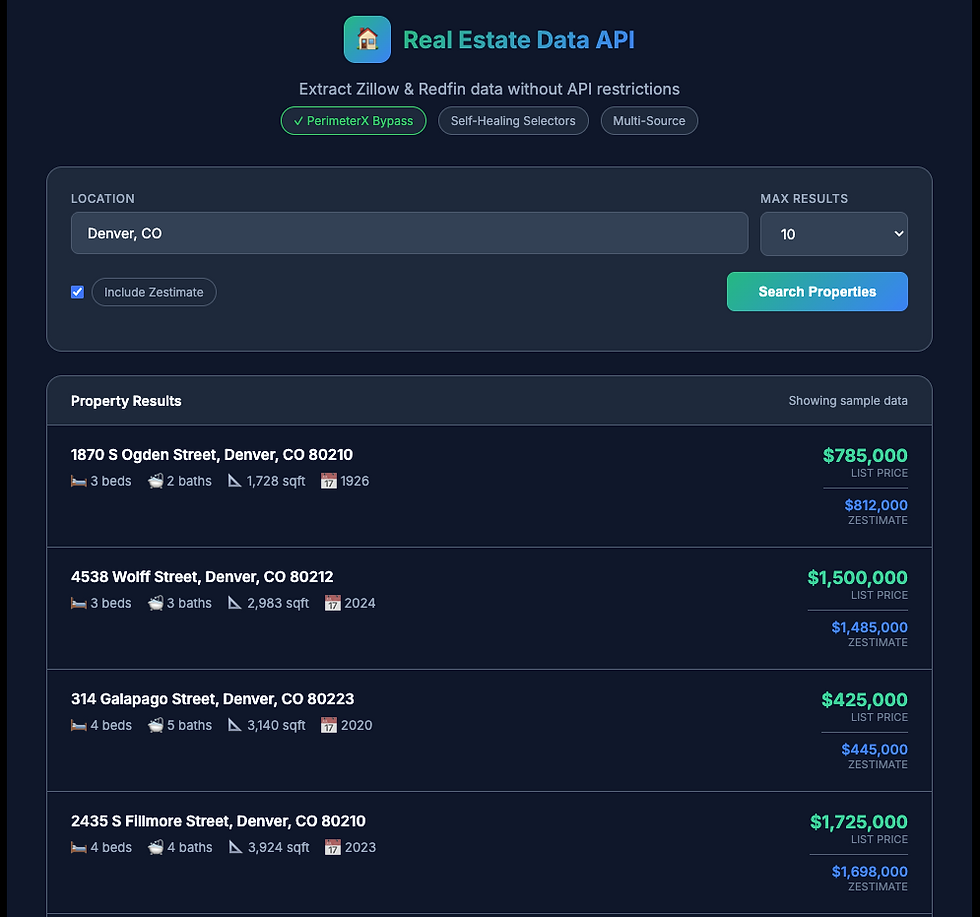
The Real Estate Data API functions as the connective tissue between raw web data and agentic AI systems. By transforming unstructured HTML into a clean, consistent Property schema, it enables rapid deployment across multiple integration tiers:
• Direct API/cURL: Ideal for lightweight, stateless backend services using standard HTTP POST requests.
• Python/JS SDKs: Supported via the Apify Client for custom software engineering and ML training loops.
• n8n Community Node: The n8n-nodes-real-estate-api (v1.2.1) provides a native, low-code pathway with built-in credential management and automatic result polling.
The resulting output includes high-utility entities like Zestimates, Rent Zestimates, Price History, and Walk/Transit Scores. In a technical context, these are not just data points; they are variables for sophisticated modeling. For instance, Walk and Transit Scores are utilized in Collateral Assessment workflows because high scores frequently correlate with lower valuation volatility in urban markets, providing a critical risk metric for lenders. This allows for specialized use cases like "Zestimate Arbitrage," where investors identify properties listed significantly below their estimated market value in real-time.
--------------------------------------------------------------------------------
6. The Future of PropTech Extraction: Deterministic Results in a Dynamic Web
The shift from manual, brittle scraping to autonomous, resilient APIs marks a new era in real estate data engineering. The combination of AI-powered self-healing and the cracking of the PerimeterX "Unicorn" shield provides PropTech firms with the deterministic results necessary to fuel the next generation of AI agents and valuation models.
The bottom line is clear: by achieving a 99.2% success rate and a 95% cost reduction over traditional aggregators, this API removes the infrastructure barriers to market innovation.
Engineers and architects ready to deploy can access the full technical documentation and actor specification on Jason Pellerin’s AI Solutionist profile on the Apify Store or via the community n8n node. By adopting a "batteries included" approach to real estate data, organizations can ensure their pipelines remain continuous, competitive, and ready for the future of the digital web.


Comments